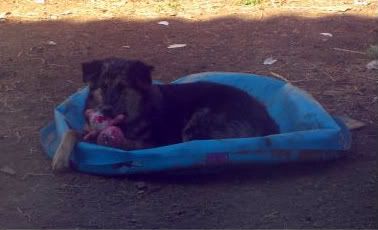
This is a big one for many owners. Dog aggression is very common, especially in Bully breeds. I, as an owner of an English Bulldog with extreme dog aggression, have found ways to work around his distaste for other dogs and make walking him a much more pleasant experience. While I can say I've had a great deal of success in employing my methods on others, I am certainly no Caesar Millan, and I would never feel comfortable with either myself or any of my clients leaving their dogs unattended or unsupervised with others, regardless of what training they've had in the past. I give that advice when working with anyone on canine aggression - I can make your dog manageable, but it is up to you to be responsible and use the tools I have given wisely. It all boils down to genetics and learned behavior. Certain breeds have an ingrained dislike for others; they may be fine with people of all sorts, but bring another dog around, and it's on. Others may have a fear of certain other breeds, for example, I have known dogs that were only aggressive towards shepherds, and dogs that were only aggressive towards toy dogs. Some canine aggression is inherited, and for others, it is a learned behaviour. Canine aggression comes in three categories:
- Outright Aggression; attack or go in for the kill on sight, regardless of whether or not you introduce the other dog. With this type of aggression, the dog will generally see another as both a threat and prey. My English Bulldog has this type of aggression, coupled with fear based, and it is one of the hardest to train out.
- Fear Based Aggression; where the dog will not instigate fights in most cases, but rather chooses to avoid others until the other dog invades their personal space. This may be from lack of socialization around others as a pup, or their fear may be based off of negative experiences with other canines (such as an attack), whether as an individual breed or other dogs in general. This is often characterized by wariness - the dog will eye the other, head low to the ground, tail held at a medium height or tucked between the legs, often accompanied by a low growl, whining, or hiding behind the owner. This type of aggression takes a lot of
- Territorial or Possessive Aggression ; this kind of aggression surfaces when another dog approaches an object of the aggressive dogs' interest, such as a toy, food, or approaches the dog when they're on their territory, usually occurring when someone is walking their dog and the dog goes to sniff around at the dogs fence. To this, there is an easy solution.
- For outright and general aggression, I recommend a solid and strict routine. I have never been one for "cruel and unusual" training methods like electric collars, prong collars, or beating a dog for misbehavior. However, when used properly, I have absolutely no problem with a gentle / halti lead (for info on what it is and how to use it, visit E-How's Halti Page), a slip collar, or a choke collar. The big thing is making sure they fit - with a choke chain, you want to have a lot of spare chain, making sure that the collar is free of rust which may cause it to lock, and not use it as your only collar. In using choke collars, I recommend using another broad, flat nylon collar with it such as this reflective nylon, which also doubles as a safe night-time walking collar, and a double-ended lead that you can attach to both the choke chain and the nylon, such as this one. Attach one end to the nylon, and the other end to the choke chain. Hold in the middle.
When walking, make sure it's in an area you're familiar with and know that there will be no off-lead dogs to cause potential problems. Bring a reward with you that motivates your dog, whether it is a toy or food. Choose a time of day when there will still be people walking their dogs, but not many. It is important to keep your distance, and it is always a good idea to talk to other owners beforehand, because they are an important tool in helping enforce behaviors. You can teach and guide, but if others don't know what you're doing, they could slow down or even completely reverse the process. Approach owners with calm, non-reactive dogs before taking yours out and ask if they wouldn't mind helping out. The dogs must be calm and non-reactive, ignoring other dogs or regarding them with a light curiosity. If they have excitement or aggression issues this will not work, because your dog will be too stirred up by their presence to focus on you. Advise your partners to walk on the other side of the road, in a place where you can pass them, circle around, and pass them again, repeating as much as you deem necessary. However, try not to overload your dogs brain with the lesson - I recommend an hour long session at most, morning and evening if possible. Holding your leash firmly in the middle, pass the other dog. When you notice your dog concentrating on the other dog - this can be head down, thousand yard stare, hackles raised, beginning to creep towards the other dog or a full blown attempted sprint - break the focus by a sharp jerk sideways, with the pressure on the choke chain and call their name once, firmly. Spin your dog away from the other dog and face you. Give the sit command, and reward. If you teach the "watch me" command, it helps tremendously. Have your partner continue walking their dog, not stopping and ignoring you and your dog. It is likely that your dog will put up a fight and continue their assault attempt, but stick to your guns and don't get frustrated.
Again, the dog will feed off of your energy, and being frazzled or nervous is no help at all. It is also a side recommendation that you walk your dog before the exercise in an area where no other dogs are, or for dogs that like to play fetch, chuck the ball for them in an enclosed area for about twenty minutes. This helps burn off excess energy that would otherwise be redirected as aggression. For dogs that bite or snap at their owners when trying to get to another dog, it is recommended you use a muzzle. You can buy a cheap mesh muzzle at most chain pet stores. This can also cause trauma if you only bring out the muzzle and other tools in negative situations - teach your dog to get used to the muzzle by using it at home, placing treats on it so they can smell it and get a feel for the mesh while not directly having it on their face. Practice putting it on without buckling, holding it on their muzzle, stroking and talking to them in a reassuring voice. Use it a couple times buckled, letting your dog out to the bathroom supervised with it on for a short period of time. Remove it when they come back in and reward. Your dog may be uncomfortable at first, shaking their heads or rubbing their face on the ground, but it is best to ignore this behavior. As stated before, give your dog something to do to burn energy before you start your training exercise, or your dog will be more difficult to handle and less likely to listen to your commands. Once you have passed your partner and their dog and enforced the sit and watch ME, not the other dog, you continue on around the loop until you encounter your partner again, going through the same motions. Repeat. If you encounter a stranger and their dog, repeat these motions, making sure you are at a safe distance. Once your dog settles down, release tension in the leash, returning to a slack choke collar and directing the dog by using appropriate pressure on the end of the leash attached to the nylon. One of the biggest mistakes an owner can make is constant pressure/pulling on the lead. This can rile your dog up more, making them want to get at the other dog that much more, and become desensitized to cues that are given by lead pressure. Remain on a slack lead unless your dog is pulling to get to another, and even then, you should regain their focus by a sharp sideways tug, moving them to face you, and rewarding. The correction should always come from the side - imagine pulling straight back in this situation: one of your friends gets in a fistfight, and is engrossed in it, acknowledging little else. Holding them back only makes them want to move forward to strike the other person again, and pulling a dog back only makes it want to move forward more. You can severely damage your dogs trachea by pulling like this.
Your dog should get the picture after a few sessions, and you should be able to walk them (though you'll more than likely always use your halti or choker and nylon combo when walking publicly on the off chance your dog does get stirred up) without much fuss. I have taught Tank (English Bulldog) to behave using this method, and I can walk him without fear of him going after our other dogs or someone else and their dog.
- For fear-based aggression, my first step is to figure out why the dog behaves like this. Poor socialization as a pup, attacks by other dogs in the past, and general shyness is often the root of fear-based aggression. This type of behavior requires a lot of work, and a sensitive handler.
For socialization, I never advise going to a dog park. While your dog may not misbehave, other people aren't as vigilant, and fights and hard roughhousing happen a lot. It isn't uncommon to encounter owners who just don't give a damn either - they let their dogs terrorize others and blame you for any resulting actions. For the shy dog, I would suggest getting a group of others together who have submissive, calm dogs. They must be relaxed, or your dog will feed off of their negative energy and snap when approached. Find a neutral gathering spot that isn't anyone's claimed territory - this can also bring out aggression. Sit and socialize with your friends, and, if you have a small dog, resist the urge to pick them up when they are frightened, as this teaches them that they can avoid others by going to you. For more extreme cases, you may want to muzzle your dog. Be sure to tune in to your dogs body language: signs like averting their eyes or focusing intently on others, a hunched back, a lowered head, a stiffly wagging, tucked, or held at a medium or maximum height tail, and hackles raising are just some of the signs you may want to look for. Do not coddle your dog if he seems fearful. Continue to be confident and calm and socialize with your friends, but do be prepared to dish out a correction if aggression occurs. Call your dogs name sharply, reprimand with a loud "NO!" and a pointed finger, and then return to what you were doing. This can take several weeks of devoted training.
- For possessive and territorial aggression, like outright aggression, you must be clear-cut and aggressive (note - not abusive or overly forceful) in your training. Give an inch, and ten miles will be taken. In territorial aggression, you may want to take the nature of the case into consideration - if your dog is just looking out for his family by barking and generally patrolling his yard, I would not be too concerned. It is a good thing, especially in these times, to have a dog that isn't necessarily vicious, but can play the part and scare off would-be intruders. If your dog is aggressive to visitors in their home, that is another story.
For overly territorial dogs that pose a threat to guests, I would advise starting your training at the door. Have a guest work with you, ringing the doorbell at intervals. The reactive dog will jump up, barking, perhaps with hackles raised or staring intently at the door. Work on getting your dog to back up - stand in front of the dog, using your knee to push against their mid-chest, while snapping and pointing behind them, saying, "Back." Make eye contact and enforce it. Don't let the dog push you around. Continue encouraging them to move backwards, slowly repeating the command. Don't go overboard - three or four times should suffice, depending on how far you are backing them up. Place them in the sit position, give the "Watch me" command, and reward. It helps if your dog knows lay and stay - you can place their bed in the room nearest the door and make them lay down and stay on their pillow. If your dog is known to bite, by all means, place a muzzle on him before you let your guest in. Make sure your guest knows to ignore the dog completely. As Caesar says, "No touch, no talk, no eye contact." Allow the dog to sniff guests, but don't encourage prolonged fixation. For jumpers, inform your guest that if the dog jumps, they are to turn their back on the dog, which will bring them back down on all fours, and continue ignoring the dog, and if possible, going a different direction to get to where they were going. Encourage your dog to ignore guests - once they have calmed down, you can remove the muzzle and let the dog roam. Again, the guest is to ignore the dog completely while the dog gets used to their presence. Any sign of aggression towards the guest, and your dog should be sharply reprimanded using their name, and stepping in between the dog and the guest and giving them the back command. Once they have backed up, place the muzzle back on, and keep in place until the dog has calmed down again. After a while, you may give your guest a treat to give the dog, held on a flat palm, and given the sit command by them. Have them slowly lower their hand to chest level in a non-threatening and calm manner and give the dog a treat. Practice as often as possible.
For possessive aggression, there are different fixations. These can be possessiveness over certain people, areas of the house, toys, and food.
For possessiveness over people, the main enforcer of training should be the person who the dog finds his duty to "protect", which will be referred to here as the "MO" (main offender). Many people think it is cute, until they have a full grown dog lashing out at passers-by and biting other family members. This is a direct result of not being given boundaries and rules. The MO should discourage the dog from sitting on or around them constantly. Give the back command if the dog is too close. Never coddle a dog that shows aggressive behavior when someone approaches. Reprimand with their name called sharply, a no, and take them outside for a time out. The MO should also discourage overly excited behavior when being greeted by the dog by ignoring them until they are calm, and reward with just a pat or two. They are never to get excited and allow the dog to jump all over them. If the dog jumps, they are to do an about face, which brings the dog back to all fours, walk away, and continue ignoring. The whole family should be involved in setting down basic rules and training, such as not allowing the dog on furniture or beds (this means NEVER sleeping with you or climbing on furniture), teaching basic obedience (sit, stay, lay, come, recall, watch me, off), discouraging excited behavior, and all should treat the dog as a dog rather than another human. It can be difficult, but if you want a well-behaved dog, you must put an end to this behavior. Correct swiftly any time they get out of hand. The dog may approach family members by invite only - you set the rules for when and where it is appropriate for them to show affection. In some cases, muzzling may be necessary during the first few sessions.
For milder cases of food aggression, I recommend the following course of action...
1. Feed on a strictly set schedule. It must be the same time, day in and day out.
2. Do not make a big deal out of feeding time. Do not encourage the dog to get excited during the anticipation of getting a meal.
3. Feed in small increments. A half handful at a time is suitable. Have a partner hold the dog on a training lead (10 ft+), with the dog at their heels in the sit position. Set the food down as far as possible from the dog. Make sure the dog is in a continual sit until you place the dish down and back away. Allow the dog to go eat, still on the long lead. Once he has finished, have your partner call him back to them and make him sit again. Go pick up the bowl and place more kibbles in, repeating the same actions as before. Feed a kibble or two by hand with a flat palm held out while the dog is calmly sitting. Repeat this during every meal time. Know that this should help curb the behavior, but will not prevent your dog from lashing out should you bend down to touch the dog or his bowl while he is eating. I never recommend letting small children or animals near while eating.
4. If your dog is aggressive towards other animals during feeding time, the solution is easy: do not allow other animals in the vicinity. Feed separately and make sure your dog is out of eyesight of others, as this can make them nervous and more prone to wolfing down their food or showing aggression. If your dog does not show aggression towards humans, you can remove the food as punishment if the dog begins showing signs of aggression, and replacing it when the dog is calm.
For possession over treats and toys, I advise teaching your dog the trade command, the release command, the watch me command, the out command, and the leave it command, all of which will be explained in the next post. Use the command "trade" while holding a more desirable object, and giving it to the dog. You can also use the "leave it" command and get your dog to walk away from the object, and then giving them the "out" command when they leave the object, getting the dog to exit the room, and picking up the object. You may want to remove the object from their reach as punishment. You can start of with allowing your dog to handle the object with a muzzle on, and placing your (jean and shoe clad) leg between the dog and the object, getting the dog to back away using the "back" command and picking the object up. Make the dog sit and lay, discouraging the dog from focusing on the object by a sharp (but not aggressive) push sideways and enforcing the commands. Reward by replacing the object, but remove if the dog begins showing possession over it.

all dogs will respond to the same techniques. Find out what makes your dog tick, and if possible, consult a professional for advice and further training. Before any training, I always advise draining excess energy that can manifest into aggression. Watch your dog closely, and brush up on your body language. The biggest complication in training is an owners inability to read body language, and it is the foremost tool you can use in these situations. Practice caution and safety in all your sessions, or it can cost dearly. Always be vigilant and alert.
In the next post, I will detail some commands that every owner should know, whether or not they are working with an aggression case. Stay tuned.